sábado, 26 de noviembre de 2016

Pascal

Blaise Pascal (/pæˈskælpɑːˈskɑːl/;[2] French: [blɛz paskal]; 19 June 1623 – 19 August 1662) was a French mathematicianphysicist, inventor, writer and Christian philosopher. He was a child prodigy who was educated by his father, a tax collector in Rouen. Pascal's earliest work was in the natural and applied sciences where he made important contributions to the study of fluids, and clarified the concepts of pressure and vacuum by generalising the work of Evangelista Torricelli. Pascal also wrote in defence of the scientific method.
In 1642, while still a teenager, he started some pioneering work on calculating machines. After three years of effort and 50 prototypes,[3] he built 20 finished machines (called Pascal's calculators and later Pascalines) over the following 10 years,[4] establishing him as one of the first two inventors of the mechanical calculator.[5][6]
Pascal was an important mathematician, helping create two major new areas of research: he wrote a significant treatise on the subject of projective geometry at the age of 16, and later corresponded with Pierre de Fermat on probability theory, strongly influencing the development of modern economics and social science. Following Galileo Galilei and Torricelli, in 1646, he rebutted Aristotle's followers who insisted that nature abhors a vacuum. Pascal's results caused many disputes before being accepted.
In 1646, he and his sister Jacqueline identified with the religious movement within Catholicism known by its detractors as Jansenism.[7] His father died in 1651. Following a religious experience in late 1654, he began writing influential works on philosophy and theology. His two most famous works date from this period: the Lettres provinciales and the Pensées, the former set in the conflict between Jansenists and Jesuits. In that year, he also wrote an important treatise on the arithmetical triangle. Between 1658 and 1659 he wrote on the cycloid and its use in calculating the volume of solids.
Pascal had poor health, especially after the age of 18, and he died just two months after his 39th birthday. 

Newton

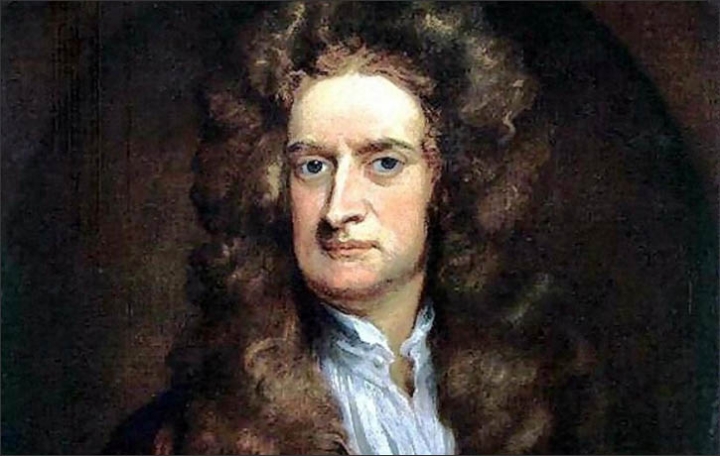
Sir Isaac Newton FRS (/ˈnjtən/;[6] 25 December 1642 – 20 March 1726/27[1]) was an English physicist and mathematician (described in his own day as a "natural philosopher") who is widely recognised as one of the most influential scientists of all time and a key figure in the scientific revolution. His book Philosophiæ Naturalis Principia Mathematicalis Principia Mathematica ("Mathematical Principles of Natural Philosophy"), first published in 1687, laid the foundations for classical mechanics. Newton made seminal contributions to optics, and he shares credit with Gottfried Wilhelm Leibniz for the development of calculus.
Newton's Principia formulated the laws of motion and universal gravitation, which dominated scientists' view of the physical universe for the next three centuries. By deriving Kepler's laws of planetary motion from his mathematical description of gravity, and then using the same principles to account for the trajectories of comets, the tides, the precession of the equinoxes, and other phenomena, Newton removed the last doubts about the validity of the heliocentric model of the Solar System. This work also demonstrated that the motion of objects on Earth and of celestial bodies could be described by the same principles. His prediction that Earth should be shaped as an oblate spheroid was later vindicated by the measurements of MaupertuisLa Condamine, and others, which helped convince most Continental European scientists of the superiority of Newtonian mechanics over the earlier system of Descartes.
Image result for isaac newtonNewton built the first practical reflecting telescope and developed a theory of colour based on the observation that a prism decomposes white light into the many colours of the visible spectrum. He formulated an empirical law of cooling, studied the speed of sound, and introduced the notion of a Newtonian fluid. In addition to his work on calculus, as a mathematician Newton contributed to the study of power series, generalised the binomial theorem to non-integer exponents, developed a method for approximating the roots of a function, and classified most of the cubic plane curves.
Newton was a fellow of Trinity College and the second Lucasian Professor of Mathematics at the University of Cambridge. He was a devout but unorthodox Christian,[7] and, unusually for a member of the Cambridge faculty of the day, he refused to take holy orders in the Church of England, perhaps because he privately rejected the doctrine of the Trinity. Beyond his work on the mathematical sciences, Newton dedicated much of his time to the study of biblical chronology and alchemy, but most of his work in those areas remained unpublished until long after his death. In his later life, Newton became president of the Royal Society. Newton served the British government as Warden and Master of the Royal Mint.

Einstein

Albert Einstein

From Wikipedia, the free encyclopedia
"Einstein" redirects here. For other uses, see Albert Einstein (disambiguation) and Einstein (disambiguation).
Albert Einstein
Einstein 1921 by F Schmutzer - restoration.jpg
Albert Einstein in 1921
Born14 March 1879
UlmKingdom of WürttembergGerman Empire
Died18 April 1955 (aged 76)
Princeton, New JerseyUnited States
ResidenceGermany, Italy, Switzerland, Austria (present-day Czech Republic), Belgium, United States
Citizenship
FieldsPhysicsphilosophy
Institutions
Education
ThesisEine neue Bestimmung der Moleküldimensionen (A New Determination of Molecular Dimensions) (1905)
Doctoral advisorAlfred Kleiner
Other academic advisorsHeinrich Friedrich Weber
Known for
Influenced
Notable awards
SpouseMileva Marić (1903–1919)
Elsa Löwenthal (1919–1936)[2][3]
Children"Lieserl" (1902–1903?)
Hans Albert (1904–1973)
Eduard "Tete" (1910–1965)
Signature
Albert Einstein (/ˈnstn/;[4] German: [ˈalbɛɐ̯t ˈaɪnʃtaɪn]; 14 March 1879 – 18 April 1955) was a German-born theoretical physicist. He developed the general theory of relativity, one of the two pillars of modern physics (alongside quantum mechanics).[1][5]:274 Einstein's work is also known for its influence on the philosophy of science.[6][7] Einstein is best known in popular culture for his mass–energy equivalence formula E = mc2 (which has been dubbed "the world's most famous equation").[8] He received the 1921 Nobel Prize in Physics for his "services to theoretical physics", in particular his discovery of the law of the photoelectric effect, a pivotal step in the evolution of quantum theory.[9]
Near the beginning of his career, Einstein thought that Newtonian mechanics was no longer enough to reconcile the laws of classical mechanics with the laws of the electromagnetic field. This led to the development of his special theory of relativity. He realized, however, that the principle of relativity could also be extended to gravitational fields, and with his subsequent theory of gravitation in 1916, he published a paper on general relativity. He continued to deal with problems of statistical mechanics and quantum theory, which led to his explanations of particle theory and the motion of molecules. He also investigated the thermal properties of light which laid the foundation of the photon theory of light. In 1917, Einstein applied the general theory of relativity to model the large-scale structure of the universe.[10][11]
He was visiting the United States when Adolf Hitler came to power in 1933 and, being Jewish, did not go back to Germany, where he had been a professor at the Berlin Academy of Sciences. He settled in the U.S., becoming an American citizen in 1940.[12] On the eve of World War II, he endorsed a letter to President Franklin D. Roosevelt alerting him to the potential development of "extremely powerful bombs of a new type" and recommending that the U.S. begin similar research. This eventually led to what would become the Manhattan Project. Einstein supported defending the Allied forces, but largely denounced the idea of using the newly discovered nuclear fission as a weapon. Later, with the British philosopher Bertrand Russell, Einstein signed the Russell–Einstein Manifesto, which highlighted the danger of nuclear weapons. Einstein was affiliated with the Institute for Advanced Study in Princeton, New Jersey, until his death in 1955.
Einstein published more than 300 scientific papers along with over 150 non-scientific works.[10][13] On 5 December 2014, universities and archives announced the release of Einstein's papers, comprising more than 30,000 unique documents.[14][15] Einstein's intellectual achievements and originality have made the word "Einstein" synonymous with "genius".[16]